Why boxwood is the default
Its leaf pattern is small, dense, and uniform, which means panels look full even at close range and seams between panels are easier to hide. That combination makes it the usual choice for privacy screening and decorative work alike.
Real boxwood hedges can work in parts of California, but they need consistent irrigation, regular shaping, and years of grow-in time before they screen anything. In drought-prone areas, keeping a living boxwood hedge at privacy height is a significant ongoing water commitment.
Artificial boxwood panels skip all of that. You get the full screen on the day of installation, with no irrigation infrastructure, no grow-in period, and no seasonal dieback. The tradeoff is that you lose the seasonal variation of a living plant, but for most privacy applications, consistency is the point.
So the useful question is not whether boxwood is the usual choice. It is whether a boxwood hedge is the right build for your actual fence, wall or project edge.
Where boxwood privacy hedges work best
Boxwood hedge panels are versatile, but certain applications come up more than others across California properties.
Residential patio and pool screening. Poolside privacy is a common reason to screen. Boxwood panels provide immediate screening without the root intrusion, leaf drop, or pest issues that come with planted hedges near pool equipment and decking.
Property-line privacy on side yards and backyards. Narrow side yards often lack the soil volume for dense planting. Boxwood panels mounted to an existing fence or a simple metal frame deliver full coverage in inches of depth rather than feet.
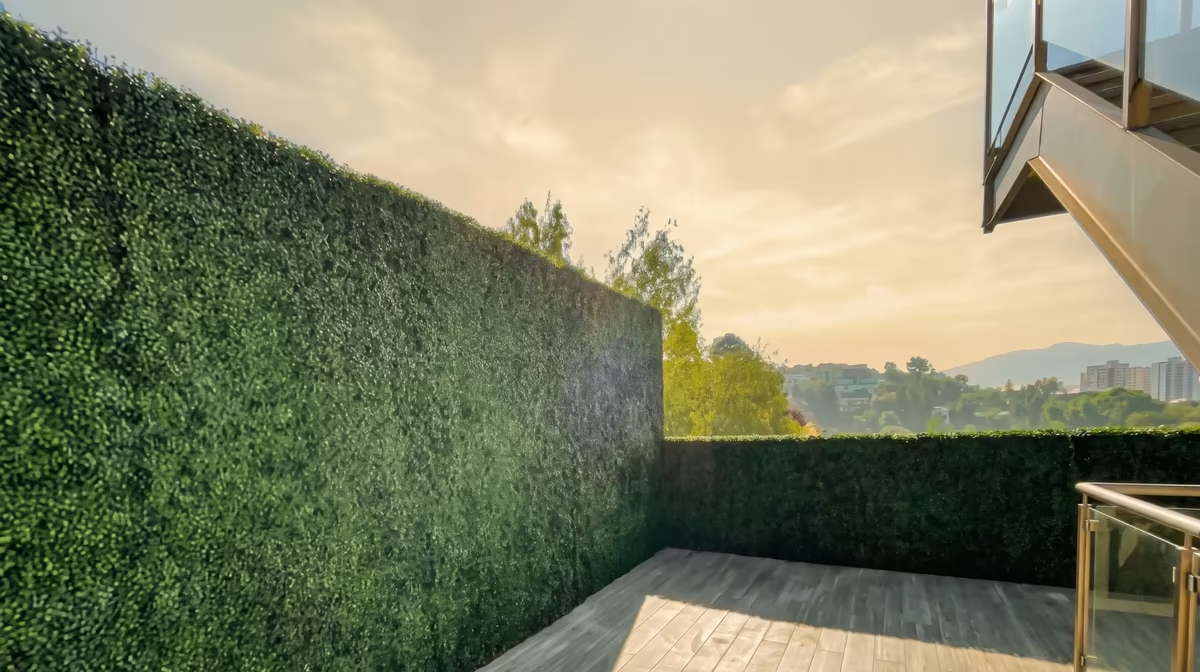
Rooftop deck and balcony screening. Elevated outdoor spaces have limited planting options and high wind exposure. Boxwood panels add privacy without the weight of soil and planters, provided they are secured against wind load.
Restaurant and hospitality outdoor dining. Dining patios need consistent visual separation that holds up to foot traffic and chair bumps. Boxwood hedges create defined zones without blocking airflow the way solid walls do.
Commercial frontage and entry features. Retail and office entries use boxwood panels to add texture and a maintained appearance to blank walls, utility enclosures, and parking structures.
In California they also suit coastal properties, where salt air and wind stress living plants, and drought-conscious landscapes, where taking irrigation out of a screening job is a practical decision.
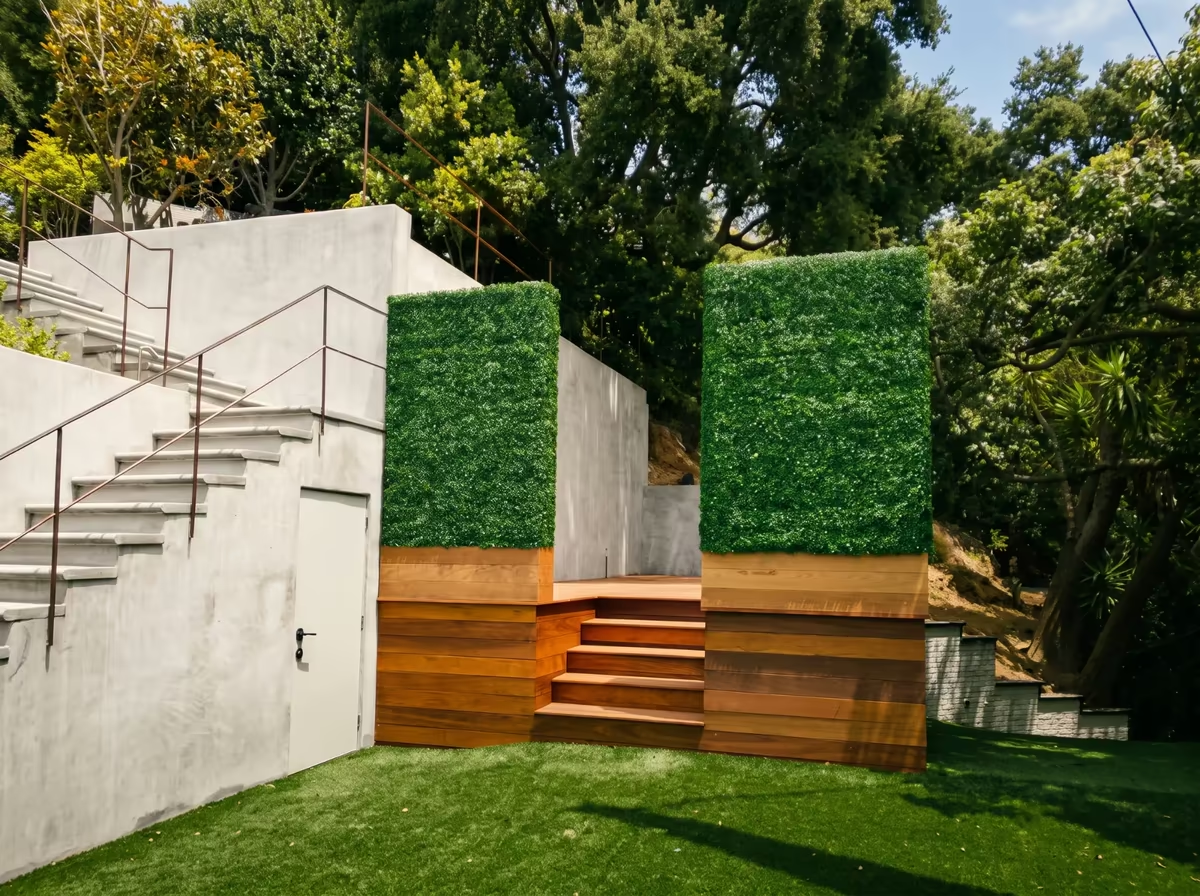
Boxwood is strongest where the project wants a familiar privacy screen on a fence, a patio or a hospitality edge. It is less convincing where the design calls for an architectural wall surface, or a taller feature that should read as a built backdrop rather than a hedge.
Two hospitality jobs in boxwood
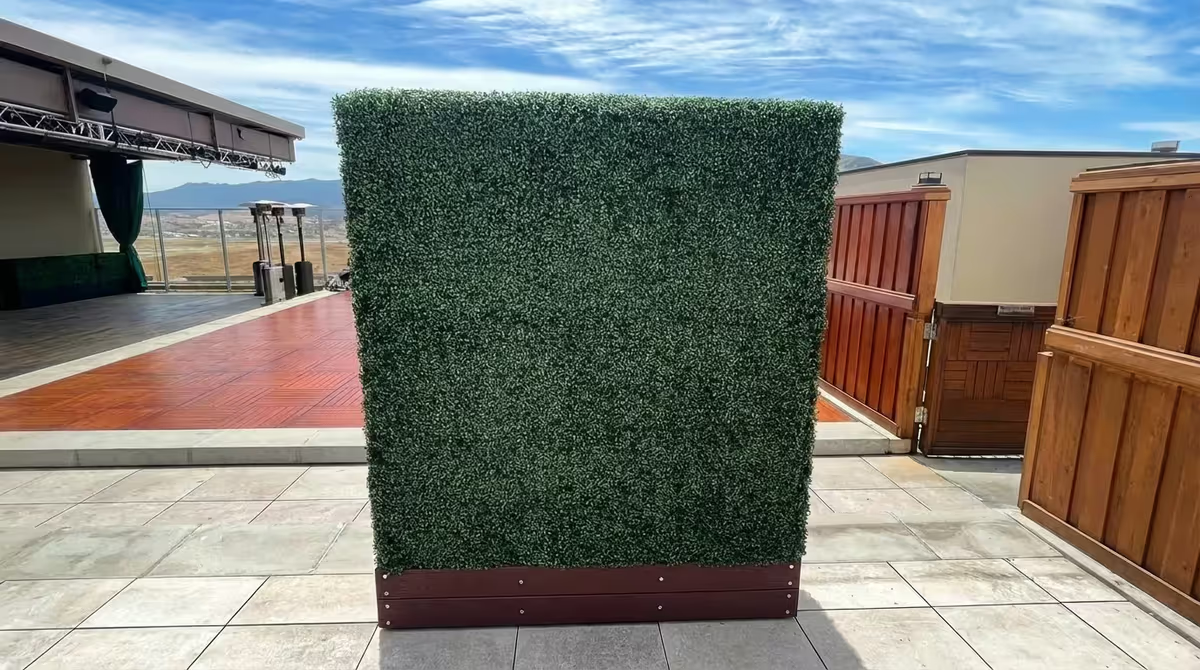
At L'Auberge Del Mar, the hotel was renting hedges for every wedding on its oceanfront deck. It needed hedges it could set out quickly, store easily and count on to look the same every time, so we built artificial boxwood units on weighted bases with locking casters. It is the reference for privacy that has to repeat.
The Jamul casino boxwood project is the reference for exterior use and a custom base. The casino's earlier hedges, from another seller, were not made for outdoor use and their base was failing, so rather than brace it we rebuilt the run on a new custom composite wood base with our artificial boxwood panels.
What to evaluate before choosing a boxwood hedge system
Not all boxwood panels are equivalent. The specifications that matter most for outdoor privacy applications in California:
UV stabilization rating. This is the single most important spec for California installations. Panels without adequate UV stabilizers can fade and turn brittle early in full sun. Ask for the specific UV stabilization standard and duration tested, not just a claim of "outdoor rated."
Panel density and leaf count per square foot. Denser panels provide better privacy and a more convincing appearance. Lower-density panels may look acceptable on a product page but appear thin and see-through once installed. Ask for leaf count per panel or per square foot so you can compare products objectively.
Backing material and mounting system. The backing grid determines how panels attach, how rigid they stay over time, and whether they can handle wind without warping. Wire grid backings are standard. Plastic grid backings are lighter but can flex in heat.
Fire testing documentation. For commercial installations, NFPA 701 testing (Test Method 1 or 2) is commonly required for decorative materials. Some jurisdictions also reference ASTM E84 for surface burning characteristics. If your project is commercial, get the test report before ordering, and confirm what your local Authority Having Jurisdiction (AHJ) requires.
Warranty coverage. Read the actual warranty document, not the marketing summary: whether it covers fading and for how long, and what it excludes (wind damage and improper installation are common exclusions).
Panel size and seam handling. Standard panels are typically 20" x 20" or 40" x 40". On longer runs, how seams are joined matters more than the panel itself. Look for interlocking edge systems and ask how the installer handles corners, top edges, and transitions.
What makes a boxwood hedge read finished
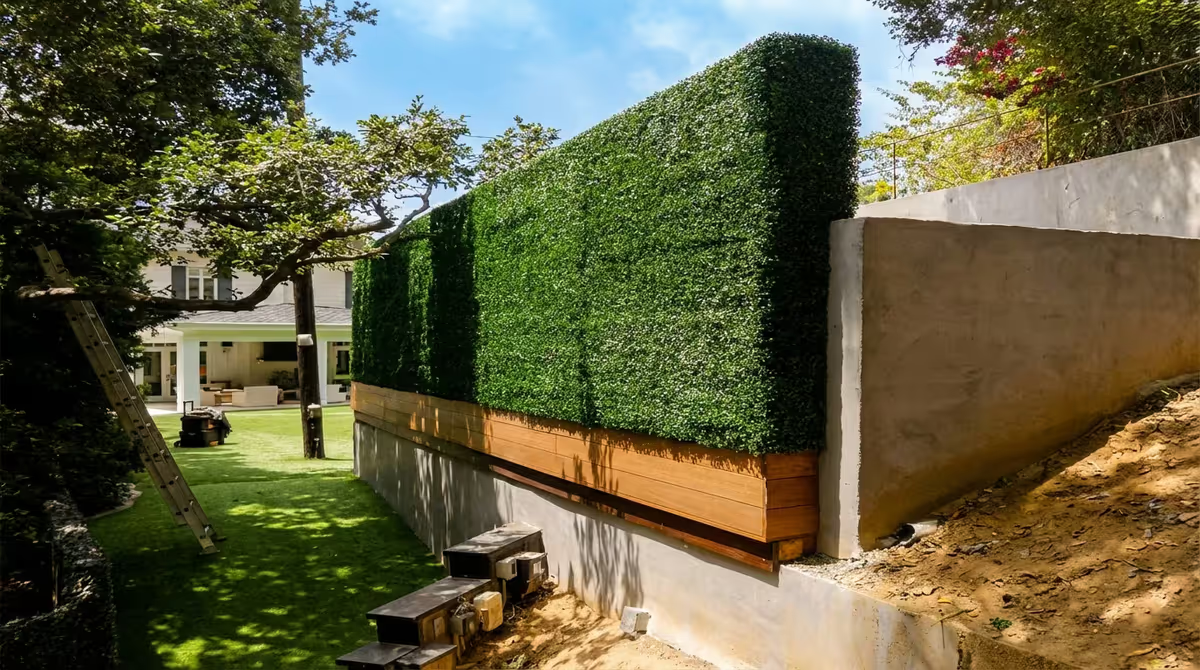
The hedges that read finished rather than flat share three things: panels dense enough to look complete at close range, mixed leaf textures that break up the repeating pattern, and a top line and edges detailed to follow the property instead of fighting it. That is why a spec sheet alone is not enough: the installation still controls the final look.
Boxwood hedges vs other privacy screening options
Boxwood hedge panels are not the only way to add privacy. How they compare to the alternatives:
Vs natural boxwood: Artificial panels eliminate irrigation, grow-in time, blight risk, and trimming schedules. You lose seasonal variation and the organic imperfection of a living plant, but the screening function is identical from day one. For a detailed comparison, see the artificial vs natural hedges guide.
Vs solid walls and architectural screens. A solid wall or screen gives a clean, architectural look. Boxwood hedges give a softer, textured appearance and let some air through. The choice is usually aesthetic, though hedges can be easier to modify or remove later. Where there is no fence or wall to mount to, a privacy wall stands the same boxwood on its own base, and it can be the cleaner fit when the project wants a more architectural screen.
Vs fence extensions. If the property already has a serviceable fence, this is the first comparison to make: a hedge face on the fence, or an extension above it. Fence extensions add height to an existing fence. Boxwood hedge panels can serve as the extension material, or they can cover the full fence face for a different look. Extensions add height; hedge panels add both height and density.
For budget planning across these options, the California artificial landscaping cost guide sets out the starting prices and what moves them.
Installation considerations for California properties
A boxwood hedge panel is only as good as the installation behind it. Several factors specific to California projects affect how the work is planned and executed.
Substrate assessment. Panels need to attach to something structurally sound. Common substrates include wood fencing, vinyl fencing, metal posts and frames, block walls, and stucco. Each requires a different fastening approach. A site visit should confirm substrate condition before materials are ordered.
Height and wind load. Taller hedge installations and hedges in exposed locations (rooftops, hillsides, coastal bluffs) act as wind sails. The mounting system needs to account for this. In a windy spot, an underbuilt mount is the weak point.
Coastal vs inland UV exposure. Coastal California gets marine layer cover that reduces peak UV intensity compared to inland valleys and desert-edge areas like the Inland Empire or Coachella Valley. That said, coastal UV is still significant. Panel spec should be based on the actual site exposure, not a generic "California" assumption.
Access and staging. California properties often have tight side yards, shared driveways, and limited staging areas. For hillside or elevated installations, equipment access and material staging need to be planned before the crew arrives.
Typical timeline. The process runs from a quick call to an online site review (a render on your photo, with an intro estimate), then a free, no-obligation site visit in Southern California for the final estimate, then production and install. How long it takes depends on material availability and site complexity. Califauxscapes handles measurement, fabrication coordination, and installation as a single scope.
Common questions about boxwood privacy hedges
How long do artificial boxwood hedges last outdoors?
The mats in our library have an expected outdoor life of 5–7+ years (Geranium Street lookbook), depending on sun exposure, coastal conditions, and whether periodic cleaning is performed. That is not the warranty, which is a 3–5 year limited UV fading warranty (varies by product line) plus a 1-year installation workmanship warranty. Panels in full afternoon sun on a south- or west-facing wall will age faster than panels in partial shade. Replacing individual panels is straightforward if one section degrades before the rest.
Do artificial boxwood hedges look realistic?
Higher-quality panels use varied leaf sizes, multiple shades of green, and a matte finish that avoids the plastic sheen of cheaper products. From normal viewing distances (six feet and beyond), well-installed panels look convincing. The installation quality matters as much as the panel itself. Clean seam work, proper edge finishing, and consistent panel density are what separate a professional result from a DIY look. See privacy hedge products for examples of panel options.
Can boxwood hedge panels be installed on an existing fence?
Yes. Most boxwood panels can be mounted directly to wood, vinyl, or metal fencing using zip ties, screws, or bracket systems. The determining factors are the fence's structural condition and whether the existing height meets your screening goals. If the fence is in good shape but too short, a combination of fence extensions and hedge panels can add both height and coverage without full fence replacement; extending a vinyl fence, though, is much harder and generally not recommended.